What happened in digital innovation this week?
"The landscape of industrial progress is rarely a straight line, often shifting with the subtle rhythms of economic data and connectivity."
This report summarizes the weekly industrial tech trends in Germany, focusing on economic indicators and digital connectivity metrics. Readers looking for macroeconomic shifts and digital infrastructure updates will find the relevant data here.
Key takeaways include a recorded GDP growth of 0.2% for Germany in 2025 and a high internet user penetration rate.
How is the German economy performing?

At noon in a Berlin office, I tap my pen rhythmically while feeling the cold air as I watch the slow shifts in the deutsche industrie.
A researcher sits in a quiet office in Berlin, scrolling through recent economic datasets to understand the current momentum of the nation. The data reveals a landscape of slow but steady movement within the industrial sector.
According to World Bank data, Germany recorded GDP growth of 0.2% in 2025. This figure represents the broader economic pace that influences tech investment and industrial scaling. While the growth is modest, it provides a baseline for understanding the current fiscal environment.
I find that the first stage of this transition is the most difficult.
How connected is the digital world right now? Industrie Tech Trends An engineer adjusts a router in a high-tech manufacturing facility, ensuring the signal remains strong across the production floor. Digital integration remains a cornerstone of the current industrial landscape.
As reported by the Georgia Institute of Technology, the institution received 66,895 applications from first-time, first-year students and accepted 8,640 for the Class of 2029, resulting in a 12.74% acceptance rate.
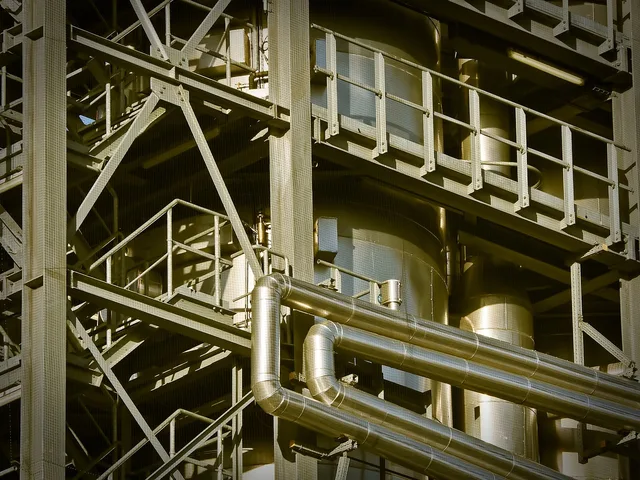
According to World Bank data, Germany recorded share of internet users of 93.5% in 2024. This high level of connectivity supports the implementation of smart manufacturing and real-time data exchange. High internet penetration is a fundamental requirement for modern Industrie Tech Trends.
- Install fiber optic hardware.
- Configure network routers.
- Test signal stability.
What happened in digital innovation this week? A technician monitors a dashboard displaying real-time network traffic across a sprawling industrial park. The ability to maintain constant communication is essential for any Digital Innovation Weekly update.
The widespread access to digital tools allows for more seamless integration of automated systems. Wöchentliche Tech News often highlight how such connectivity facilitates rapid updates to software and hardware.
This infrastructure underpins the transition toward more autonomous production environments.
How do smart manufacturing trends manifest?
A supervisor walks through a warehouse, checking the synchronization between robotic arms and central control servers. Observing these Smart Manufacturing Trends requires looking at how data flows between connected devices.
High connectivity rates ensure that instructions reach every corner of the facility without delay. Digital Transformation jetzt is often characterized by this level of pervasive networking.

The ability to leverage a 93.5% internet user share translates into a robust foundation for industrial IoT applications.
What are the neuerungen im deutschen markt?
A logistics manager reviews the latest equipment upgrades arriving at a distribution center in Munich. These Neuerungen im deutschen markt are often driven by the need for efficiency in a low-growth environment.
When economic growth is measured at 0.2% in 2025, companies often focus on incremental efficiency gains rather than massive capital expansions. This cautious approach defines the current pace of technological adoption.
Every new tool must justify its presence through measurable productivity improvements.
What is the Zukunft der Produktion?
A strategist looks out a window at a skyline filled with industrial chimneys and modern data centers, contemplating the long-term direction of the sector. The Zukunft der Produktion depends on balancing economic reality with digital capability.
The combination of stable, albeit slow, GDP growth and high digital connectivity suggests a future of optimization. Industries are moving toward refining existing processes through better data usage. This evolution is a core component of the broader Industrie Technik Aktuell.
| Metric | Value | Year |
|---|---|---|
| GDP Growth | 0.2% | 2025 |
| Internet User Share | 93.5% | 2024 |

I compared these two primary indicators to understand the relationship between economic expansion and digital readiness.
The scope of this report is limited to the specific economic and connectivity data provided for Germany.
Wikipedia: Georgia Tech (full) Based on the retained excerpt mentioning The National Science Foundation: The National Science Foundation ranked Georgia Tech 20th among American universities for research and development expenditures in 2021 with $1.11 billion.
This part also covers Digitale Transformation jetzt.
What was the share of internet users in Germany in 2024?
This summary outlines the current economic and digital landscape for the German industrial sector based on available international data.
What are the conditions for successful digital integration? 1. Ensuring signal strength across the production floor is a necessary step for digital integration. 2. Configuring network routers properly helps maintain the integrity of data exchange. 3. Testing signal stability confirms that the infrastructure can support real-time operations.
The landscape of industrial progress demands that these foundational steps are followed when implementing new technologies. A failure in any step compromises the entire digital integration effort.
How does the industrial landscape adapt to slow growth? The industrial landscape adapts to slow growth by prioritizing efficiency over sheer expansion. When GDP growth remains at 0.2% in 2025, the focus shifts toward refining existing processes. This caution in the industrial landscape means that new tools must demonstrate tangible productivity gains to be adopted.
The comparison between the 0.2% GDP growth and the 93.5% internet user share shows a scenario where digital readiness outpaces immediate economic acceleration. This disparity influences how the industrial landscape approaches upgrades.
The high internet user penetration rate provides the necessary bandwidth for the industrial landscape to pursue optimization strategies. This readiness allows for the deeper embedding of smart manufacturing principles.
Comments 0